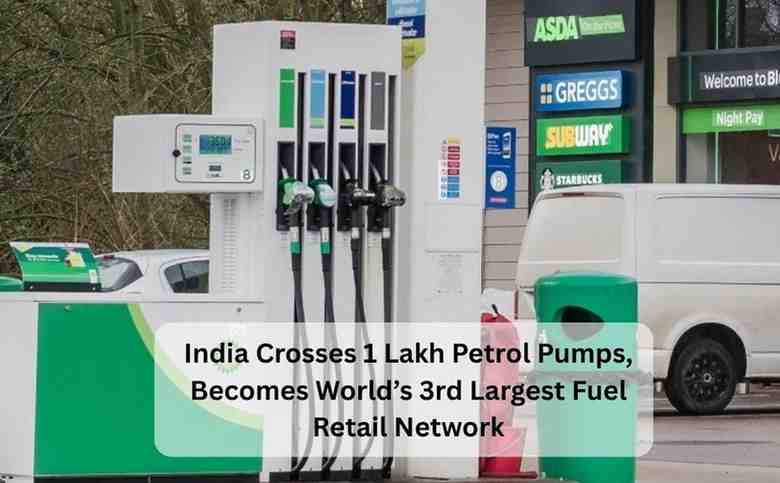
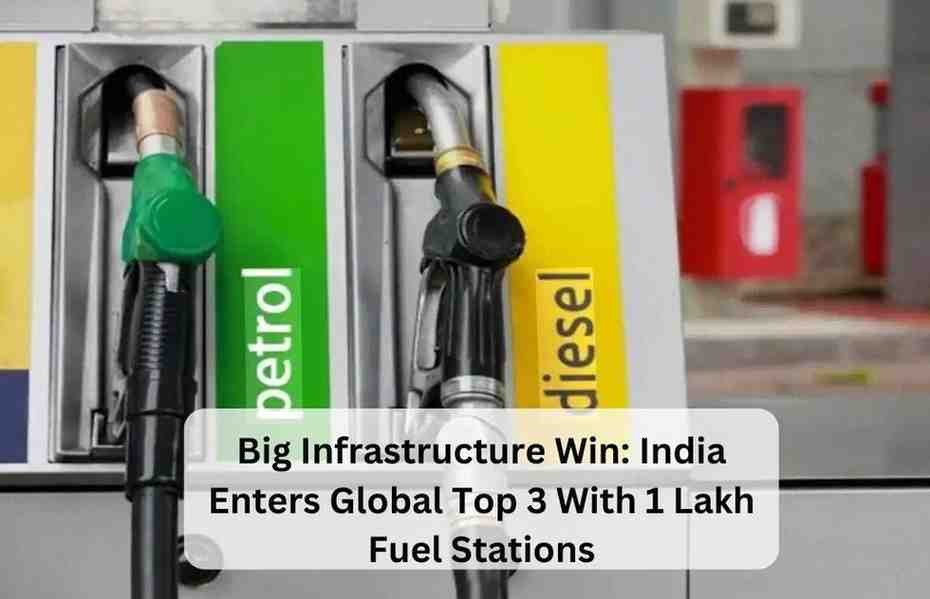
India has reached a landmark moment in its infrastructure journey — one that may not dominate headlines like a mega highway or bullet train project, but one that touches everyday life far more deeply. The country has officially crossed 1 lakh petrol pumps, making India the third-largest fuel retail network in the world, behind only the United States and China.
This is not just a statistic. It is the story of how fuel — the lifeblood of mobility and commerce — has reached the farthest corners of the country, quietly reshaping villages, highways, border areas, and emerging towns. It reflects how India’s growth is no longer limited to big cities but is spreading evenly across its vast geography.
From Urban Convenience to Nationwide Access
A decade or two ago, petrol pumps were largely clustered around cities, highways, and major towns. For millions living in rural and semi-urban areas, refueling often meant long detours, wasted time, and higher costs. Farmers transporting crops, small traders running delivery vehicles, and even daily commuters had to plan their journeys around fuel availability.
That reality has changed dramatically.
With more than 100,000 operational petrol pumps, fuel today is available:
- Near farms and mandis
- Along newly built rural and district roads
- Close to border and remote regions
- In fast-growing tier-2 and tier-3 towns
This expansion has brought tangible everyday benefits:
- Shorter travel distances to refuel
- More reliable fuel supply for agriculture and transport
- Reduced downtime for commercial vehicles
- Improved last-mile connectivity
For millions of Indians, fuel is no longer a hurdle — it is a dependable service close to home.
Why This Milestone Matters for the Economy
Fuel availability is directly linked to economic momentum. Every sector — agriculture, manufacturing, construction, logistics, tourism, and services — depends on smooth energy access.
The rapid growth of petrol pumps has supported:
- Faster inter-state movement of goods
- Reduced logistics delays and inefficiencies
- Smoother functioning of supply chains
- Expansion of highway-based tourism and trade
As national highway projects expand and freight corridors grow, petrol pumps act as critical support nodes, ensuring vehicles keep moving without disruption. In a country of continental scale, this network is what turns infrastructure plans into real economic activity.
Employment, Entrepreneurship, and Local Prosperity
Each petrol pump is more than a fuel outlet — it is an economic micro-hub.
Direct employment is created through station staff, managers, security personnel, and maintenance teams. Indirectly, these stations support:
- Transport and fuel delivery jobs
- Small food stalls, dhabas, and cafés
- Vehicle repair and tyre shops
- Convenience stores and rest areas
In many rural and semi-urban locations, petrol pumps have sparked entire local ecosystems, giving small entrepreneurs a stable base to build livelihoods. For youth in smaller towns, these outlets have become a steady source of employment close to home.
Strengthening National and Energy Security
A wide and evenly distributed fuel network also plays a crucial strategic role.
During emergencies such as floods, cyclones, earthquakes, or medical crises, access to fuel determines the speed of response. A dense petrol pump network ensures:
- Faster movement of rescue and relief vehicles
- Continuous supply in sensitive and border regions
- Better fuel stock distribution during demand spikes
- Reduced risk of regional shortages
In times of crisis, this infrastructure quietly becomes a national safety net — keeping essential services running when they are needed most.
The Modern Petrol Pump: Digital, Clean, and Evolving
Today’s petrol pumps are very different from those of the past. Many outlets have transformed into modern service centers equipped with:
- Digital and contactless payment systems
- Automated stock and supply monitoring
- Cleaner premises, restrooms, and waiting areas
- Food courts and convenience stores
- EV charging points at select locations
This evolution shows that India’s fuel infrastructure is not stuck in the past. It is actively preparing for a future that blends traditional fuels with electric mobility and cleaner energy solutions.
India’s Growing Global Standing
By crossing the 1 lakh mark, India has firmly established itself as a global leader in fuel retail infrastructure. This scale reflects not just population size, but planning, investment, and long-term vision.
Being ranked just behind the US and China highlights:
- India’s readiness to support large-scale mobility
- Its ability to manage complex nationwide networks
- The seriousness of its infrastructure ambitions
It sends a clear signal that India is building systems designed for sustained, long-term growth.
The Road Ahead: A Foundation for the Future
Crossing 1 lakh petrol pumps is not the final destination — it is the base on which the next phase of growth will stand.
As India moves toward a larger economy and cleaner mobility, this network will:
- Support expanding logistics and freight movement
- Enable smoother rural-to-urban connectivity
- Integrate alternative fuels and EV infrastructure
- Ensure inclusive energy access for every region
Whether it is a farmer in a remote village, a truck driver on a national highway, or a startup operating in a fast-growing town, energy access is no longer a limiting factor.
A Silent Achievement with Lasting Impact 🇮🇳
India may not celebrate petrol pumps with ribbon-cutting ceremonies, but their impact is visible everywhere — in faster journeys, thriving local markets, smoother trade, and stronger connectivity.
This milestone is a reminder that nation-building often happens quietly, one outlet at a time.
With every new petrol pump, India is not just selling fuel — it is fueling opportunity, resilience, and confidence.
And that is how a nation keeps moving forward.