US Fed Meeting Highlights: Dow Surges Nearly 500 Points as Federal Reserve Cuts Rates Again

Below is a detailed, human-style breakdown of what the Fed decided, why it matters, how investors responded, and what the policy shift could mean for the months ahead.
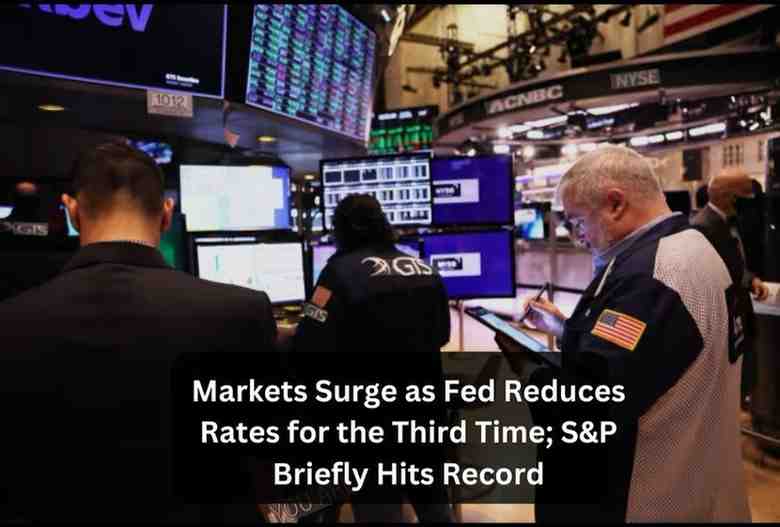
The mood on Wall Street turned noticeably upbeat on Wednesday after the U.S. Federal Reserve announced yet another cut in interest rates. This marks the third rate reduction this year, a move aimed at giving the slowing economy an extra dose of support. The moment the Fed’s decision became public, investors reacted with enthusiasm, propelling major stock indices sharply higher and lifting overall market sentiment.
A Powerful Market Rally: Wall Street Takes Off
All three major U.S. stock benchmarks ended the day with strong gains, reflecting investor relief and renewed optimism.
- Dow Jones Industrial Average soared by 497 points, finishing up about 1.1%
- S&P 500 climbed 0.7%, even flirting with a fresh record closing level of 66,890.89
- Nasdaq Composite advanced 0.5%, continuing its upward momentum
This quick surge shows how strongly markets had been waiting for clarity on the Fed’s direction. With concerns about economic softness and global uncertainty building over recent weeks, investors were eager for reassurance — and a rate cut did exactly that.
Why did markets cheer the rate cut?
Because lower interest rates:
- Make it cheaper for businesses to borrow and invest
- Encourage consumer spending
- Make stocks more appealing than bonds
- Help stabilize the economy during uncertain periods
In short, traders interpreted the latest cut as a sign that the Fed is willing to step in early and keep financial conditions supportive.
What Exactly Did the Fed Decide?
The Federal Reserve lowered its benchmark federal funds rate by 0.25 percentage points, its third consecutive quarter-point cut of the year.
But here’s the part that caught everyone’s attention:
The Fed hinted that rate cuts may pause from here.
In its policy statement, the Federal Open Market Committee (FOMC) said that future changes will depend on whether economic data clearly signals weakening momentum. This means the Fed is keeping its options open and does not plan to continue cutting rates automatically.
That’s a shift from what some investors were hoping for, and it sets the stage for a more cautious policy path ahead.
Fed Outlook: Only One Rate Cut Expected Next Year
Alongside the rate announcement, the Fed released its quarterly projections for inflation, economic growth, unemployment, and interest rates.
One of the most significant takeaways:
Fed officials now forecast just one additional rate cut next year.
This outlook is more conservative than what traders had been expecting. Many in the market had priced in two or even three cuts in the coming year, assuming the Fed would continue easing financial conditions.
The Fed’s cautious forecast indicates:
- It believes the economy remains reasonably resilient
- Inflation risks have not fully disappeared
- There is no urgent need for rapid or aggressive rate reductions
Why Did the Fed Go for a Third Rate Cut?
Several factors pushed policymakers toward another reduction:
Global growth is slowing
Weak manufacturing output, global trade tensions, and softer international demand have been weighing on the U.S. economy.
U.S. indicators are mixed
Job creation and consumer spending remain healthy, but business investment, factory activity, and exports have shown signs of strain.
Preventive strategy
The Fed is attempting what it calls a “mid-cycle adjustment” — small, early moves to prevent deeper economic damage down the line.
Market expectations
Financial markets had already priced in a cut. Holding steady might have sparked volatility or triggered fears of tightening conditions.
The Political Angle: Pressure Builds
Former President Donald Trump has long been vocal in pushing the Fed to slash rates more aggressively. He argues that cheaper borrowing costs are needed to:
- Strengthen U.S. exports
- Keep the economy competitive globally
- Support robust growth
With the Fed signaling a pause rather than an ongoing series of cuts, political criticism could intensify, especially in a climate where economic performance is often used as a measure of political success.
What Does This Mean for Investors and Ordinary Americans?
The Fed’s decision will ripple across multiple parts of the economy:
Stock Market
- Short term: Positive, as seen by Wednesday’s rally
- Medium term: Dependent on economic data and future Fed communication
- Long term: Cautious optimism, with volatility possible
Loans & Borrowing
Lower rates usually reduce the cost of:
- Home loans
- Auto loans
- Business borrowing
This can help fuel economic activity by making money cheaper to access.
US Dollar
Rate cuts often pressure the dollar downward, making U.S. exports more competitive internationally.
Bond Market
Lower rates lead to lower yields, which can boost equity valuations and push some investors toward riskier assets like stocks.
Is the Fed Preparing for Tougher Times Ahead?
The central bank appears to be navigating a very delicate balance:
- Support growth — but avoid overstimulating the economy
- Stay alert to risks — without sending a message of panic
- Adjust policy cautiously — while leaving room to act if conditions worsen
This measured approach suggests that the Fed is bracing for possible turbulence, even though current data doesn’t point to an immediate recession.
The Bottom Line
The Fed’s latest interest rate cut triggered a wave of optimism on Wall Street, pushing the Dow nearly 500 points higher in a single session. But the bigger story isn’t the rally — it’s the Fed’s message.
Future rate cuts are not guaranteed. Everything now depends on how the economy evolves in the coming weeks and months.
Investors will be watching:
- Inflation trends
- Monthly jobs numbers
- Global economic signals
- Speeches and forecasts from Fed officials
For now, markets are celebrating the Fed’s supportive stance. The real test will come as fresh economic data rolls in and the central bank decides whether its cautious approach needs to shift again.