Supreme Court’s Recent Environment Rulings Spark Fears Over the Future of India’s Natural Defences

Many fear this is not an isolated legal adjustment, but part of a broader pattern that could permanently dilute India’s environmental safeguards.
Are India’s ecological safeguards being quietly weakened?
A growing wave of concern is spreading across India’s environmental community after a series of recent rulings by the Supreme Court of India. Conservationists, former bureaucrats, legal experts, and civil society groups are warning that these decisions may mark a critical shift in how the country protects its forests, hills, and fragile ecosystems.
At the centre of the debate is a ruling that alters how the ancient Aravalli Range is officially defined — a move critics say could open vast stretches of ecologically sensitive land to mining, construction, and commercial exploitation.
Why the Aravallis Are Far More Than Just Hills
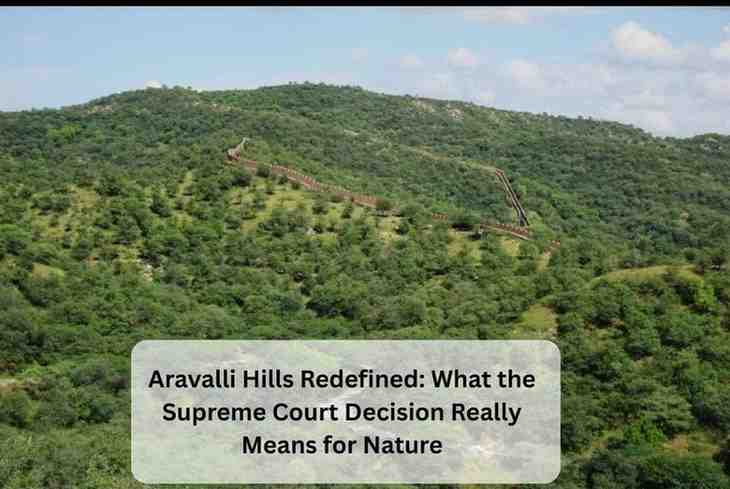
The Aravalli range is among the oldest mountain systems on the planet, older even than the Himalayas. Stretching across Delhi, Haryana, Rajasthan, and Gujarat, these hills quietly perform life-saving functions that often go unnoticed.
For decades, the Aravallis have acted as:
- A natural shield preventing the eastward expansion of the Thar Desert
- A regulator of groundwater recharge in some of India’s most water-stressed regions
- A barrier that slows dust storms and air pollution from reaching the National Capital Region
- A habitat for diverse plant and animal species that survive in semi-arid ecosystems
Environmental experts often describe the Aravallis as North India’s “green wall” — a fragile but essential line of defence against desertification, climate extremes, and worsening air quality.
Because of their importance, large portions of the Aravallis have historically been protected through forest laws, environmental regulations, and repeated court interventions.
What Changed in the Supreme Court’s Latest Decision
On 20 November, the Supreme Court accepted a new “uniform definition” of the Aravalli range prepared by a committee comprising eight officials from the Union government.
Under this revised definition:
- Only hill formations rising 100 metres above the surrounding ground level will now qualify as part of the Aravalli range.
On paper, this may appear like a technical clarification. On the ground, however, environmentalists say it is a seismic shift.
Large sections of land previously treated as part of the Aravallis may now fall outside the legal definition — instantly stripping them of long-standing protections.
Why Environmentalists Say the Impact Could Be Devastating
Activists and conservation scientists argue that the new definition could:
- Remove environmental protection from vast stretches of low-rise Aravalli terrain
- Make it legally easier to restart mining operations
- Allow construction and real estate projects in ecologically sensitive zones
- Undermine earlier Supreme Court orders that restricted exploitation
In simple terms, land that was once safeguarded as part of the Aravallis may now be treated as ordinary, developable land.
Critics warn that this reclassification does not reflect ecological reality. Even low-lying Aravalli formations play a crucial role in water absorption, soil stability, and dust control — functions that do not depend on height alone.
Former Bureaucrats Raise the Alarm
The concern deepened further when a group of retired senior civil servants, operating under the banner of the Constitutional Conduct Group, released a sharply worded open letter on December 28.
The group expressed what they called “deep anguish” over the Supreme Court’s recent environmental decisions. In unusually direct language, they warned that the court — once regarded as the last line of defence for India’s ecology — now appeared to be yielding to pressure from powerful economic interests.
According to the former officials, years of environmental jurisprudence, expert advice, and precautionary principles risk being sidelined in favour of short-term development goals.
Not One Judgment, But a Troubling Pattern
While the Aravalli ruling has drawn the most public attention, critics say it is part of a larger trend.
The Constitutional Conduct Group highlighted three separate Supreme Court judgments related to environmental governance that, taken together, they believe:
- Dilute forest and wildlife protections
- Set aside established environmental procedures
- Prioritise development projects without adequate ecological assessment
Environmental lawyers argue that this signals a shift away from the precautionary approach — a principle that guided India’s green jurisprudence for decades.
Mining: A Threat That Could Return With Force
The Aravallis have a long and painful history with mining. Illegal and semi-legal extraction once ravaged large parts of the hills, leading to deforestation, groundwater depletion, and severe air pollution.
Earlier Supreme Court interventions were instrumental in halting many of these activities.
Now, activists fear that:
- Old mining leases could be revived
- New applications may flood state governments
- Corporate lobbying could intensify
If mining returns on a large scale, experts warn of cascading consequences — from worsening air quality in NCR to falling water tables and irreversible biodiversity loss.
Public Response: Growing Anxiety and Anger
The rulings have triggered widespread reaction on social media and in public forums. Many citizens are questioning how India can claim leadership on climate action while weakening its most critical natural buffers.
Environmental scholars point out that the decision appears at odds with global commitments on climate resilience, sustainable development, and ecological justice.
For people living in and around Delhi-NCR, the issue feels deeply personal. The Aravallis are not an abstract concept — they are a living system that helps determine air quality, water availability, and public health.
What Comes Next for the Aravallis?
Legal experts expect fresh petitions seeking review or reconsideration of the ruling in the coming weeks. Environmental organisations are preparing awareness campaigns and ground-level mobilisation to highlight what they see as an unfolding ecological crisis.
Policy analysts warn that decisions made today will shape India’s environmental future for decades. Ignoring ecological science now, they say, could lead to:
- Chronic water shortages
- More frequent dust storms
- Increased heat stress and health emergencies