Silver Scripts History: Prices Cross $75 an Ounce, Redefining Global Commodity Markets

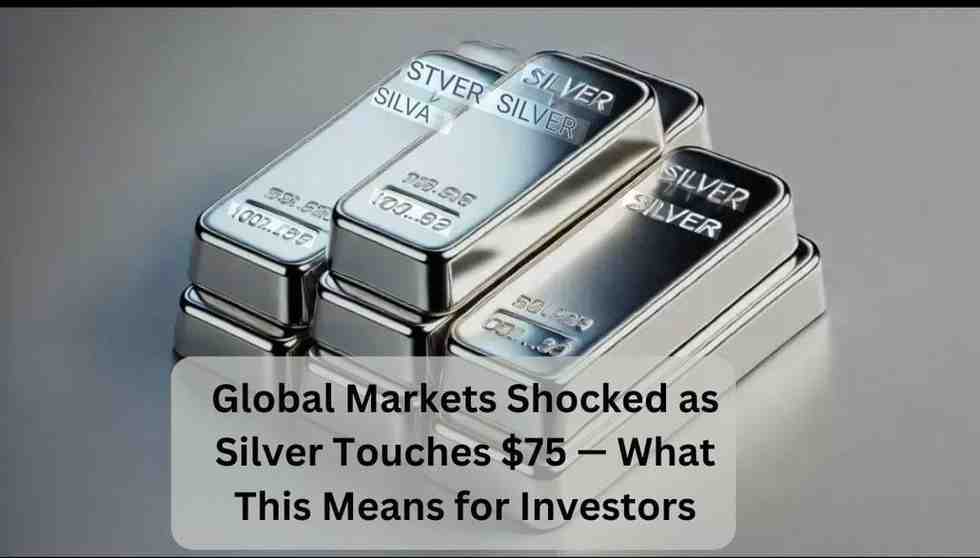
As 2025 draws to a close, global financial markets have witnessed a moment few investors ever imagined — silver, long considered the quieter cousin of gold, has surged past $75 per ounce, setting an all-time historical record. The milestone has sent ripples through commodity markets, investment portfolios, and industrial supply chains worldwide.
For decades, silver played a secondary role in the precious metals space. But this year, the metal has stepped decisively into the spotlight, delivering one of the strongest performances across all major asset classes and forcing a rethink of its role in the global economy.
A Landmark Moment for the White Metal
On December 26, silver prices climbed to approximately $75.14 per ounce, briefly touching levels never recorded before. Even after mild profit-taking, prices remained near record highs — a powerful signal of sustained demand rather than a short-lived spike.
On an annual basis, silver has risen more than 150% in 2025, far outperforming equities, bonds, and most commodities. This dramatic rally marks a turning point for a metal that had spent years trading in the shadow of gold.
Indian Markets Feel the Impact
The global surge has had an equally dramatic effect in India. Domestic silver prices soared to over ₹2.36 lakh per kilogram, hitting historic highs in major bullion markets such as Delhi, Mumbai, and Ahmedabad.
Jewellers, industrial buyers, and investors alike have been caught off guard by the pace of the rise. Many traders describe the move as “unprecedented,” noting that price jumps of this magnitude are extremely rare in the silver market.
Why Silver Is Rising So Sharply
The rally did not emerge from a single event. Instead, it reflects a powerful convergence of economic, industrial, and geopolitical forces.
Currency Weakness and Interest Rate Outlook
Precious metals tend to perform well when major currencies weaken. With expectations building that global interest rates may ease in 2026, investors have increasingly shifted capital toward hard assets. Silver, like gold, benefits from lower interest rate environments because it does not generate yield and is seen as a store of value.
Global Uncertainty and Risk Aversion
Heightened geopolitical tensions, shifting trade policies, and economic uncertainty have pushed investors toward safer assets. In times of instability, silver often attracts both defensive investors and speculative interest, amplifying price movements.
Persistent Supply Deficit
One of the most critical drivers is a structural imbalance between supply and demand. Silver has been running a production shortfall for several consecutive years. Mining output has struggled to keep pace with rising consumption, leaving inventories tight and markets vulnerable to sharp price increases.
Booming Industrial Consumption
Unlike gold, silver plays a vital role in modern industry. It is essential for electronics, solar power systems, electric vehicles, medical equipment, and advanced manufacturing. As countries accelerate investment in renewable energy and clean technologies, silver demand has surged — and there are few immediate substitutes.
Precious Metals Rise Together
Silver’s historic rally has unfolded alongside strong gains across the precious metals complex. Gold has also reached new highs, while platinum and related metals have benefited from renewed investor interest and supply concerns.
Together, these moves reflect a broader shift toward tangible assets as investors reassess risk in a changing global economic landscape.
What This Means for Investors
For investors, silver’s rise offers both opportunity and caution.
On the positive side, silver continues to serve as a hedge against inflation, currency depreciation, and economic uncertainty. Its dual role as both a precious and industrial metal gives it unique long-term demand support. Including silver in a diversified portfolio can help balance exposure to traditional financial assets.
However, the risks are equally important to consider. Silver is historically volatile, and sharp rallies are often followed by periods of consolidation or correction. Liquidity conditions — especially toward year-end — can exaggerate price swings. Investors entering at record highs must be prepared for fluctuations.
What Lies Ahead
Market opinions are divided on where silver goes next. Some analysts believe ongoing industrial demand and constrained supply could drive prices even higher in 2026. Others warn that such rapid gains may cool if global monetary policy shifts faster than expected or if speculative positions unwind.
What is beyond debate, however, is the significance of this moment. The breach of the $75 mark represents more than a price milestone — it signals a fundamental change in how silver is viewed within global markets.
Once overlooked, silver has reasserted itself as a strategic asset at the intersection of finance, industry, and energy transformation. As the world steps into a new economic cycle, the white metal’s historic rally may prove to be a defining chapter in the evolution of modern commodity markets.