Kartavya Path Draped in Indian & Russian Flags Ahead of President Vladimir Putin’s Visit — A Grand Symbol of Growing Strategic Friendship

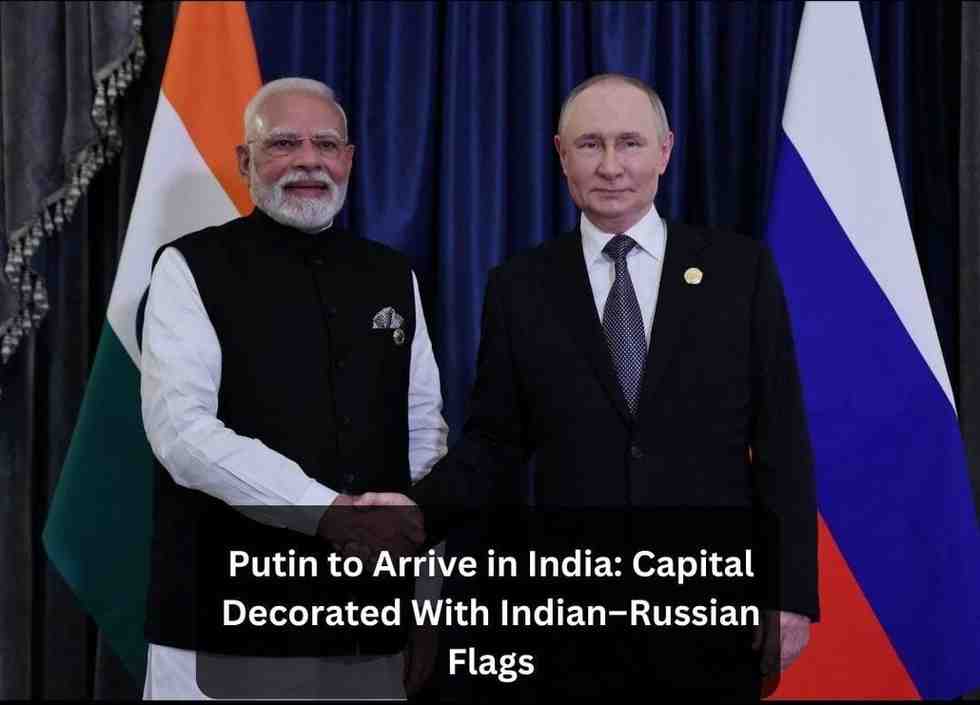
New Delhi is witnessing a striking visual spectacle this winter. As the cool December breeze sweeps across the ceremonial Kartavya Path, rows of Indian Tricolours flutter proudly alongside the Russian white-blue-red flag.
The two nations’ colours rise and fall together in the wind — a display that has instantly drawn the attention of citizens, tourists, and political observers alike.
These flags are not mere decor. They represent a moment of history as India prepares to welcome Russian President Vladimir Putin, who is arriving in the capital for one of the most closely watched diplomatic visits of the year.
A Visit Steeped in History, Strategy, and Global Relevance
President Putin’s arrival comes at a time when international relations are shifting rapidly. Major powers are adjusting alliances, strengthening regional influence, and preparing for a future defined by new strategic priorities.
In this landscape, India and Russia — two nations bound by decades of cooperation — are marking a milestone that goes beyond protocol.
25 Years of the India–Russia Strategic Partnership
This visit coincides with the 25th anniversary of the India–Russia Strategic Partnership, established in the year 2000.
Considered one of India’s most dependable international relationships, this partnership extends far beyond political goodwill. It reflects continuous cooperation in:
- Defence & Military Technology Joint projects, weapon systems, and military training programs.
- Civil Nuclear Energy Including the multi-unit Kudankulam Nuclear Power Plant in Tamil Nadu.
- Space Cooperation Satellite launches, research, and future joint missions.
- Oil & Natural Gas Long-term crude supply and investments in Siberian energy fields.
- Trade & Economic Growth Involving key sectors ranging from pharmaceuticals to engineering goods.
- Science & Innovation Exchanges
- Cultural & Educational Collaboration
Despite global tensions, sanctions, and evolving geopolitical blocks, the India–Russia friendship has remained remarkably stable.
Putin’s visit reflects not only mutual respect but also a shared intention to elevate cooperation for the coming decades.
23rd India–Russia Annual Summit: What Lies Ahead
The centrepiece of this visit is the 23rd Annual Bilateral Summit, a high-level forum where leaders review past collaboration and chart long-term strategies.
Returning after a gap triggered by the pandemic and global geopolitical shifts, this summit carries immense significance.
1. Defence Cooperation: Modernization & Joint Production
India and Russia are likely to explore:
- New phases of the BrahMos missile programme
- Expansion of joint manufacturing under ‘Make in India’
- Maintenance and upgrading of older military platforms of Russian origin
- New-generation equipment and defence technologies
2. Energy Security & Strategic Supplies
With energy markets transforming worldwide, both sides may discuss:
- Long-term contracts for crude oil
- Investments in Russian energy fields
- Broader collaboration in nuclear energy, especially at Kudankulam
- LNG supply routes and diversification of suppliers
3. Trade, Transport & Economic Diversification
Although bilateral trade has crossed $50 billion, both nations see substantial untapped potential.
Key focus points include:
- Faster transport corridors, especially through Central Asia
- New rupee–rouble payment pathways
- Lowering trade barriers for exporters
- Enhancing maritime and land connectivity
4. Global & Regional Security Dialogue
India and Russia are also expected to discuss sensitive international issues, including:
- Security and stability across the Indo-Pacific
- Evolving developments in Europe and Eurasia
- Counter-terrorism strategies and intelligence cooperation
- Defence technology transfers & joint research
This summit is set to lay out the direction of India–Russia relations for the next 10 years.
New Delhi Under Tight Security for the High-Profile Visit
Preparations are in full swing as Delhi transforms into a highly secure zone. Security forces have deployed enhanced measures across central and southern parts of the capital.
Key Security Arrangements:
- Multi-layer protection involving SPG, NSG, and Delhi Police
- High-resolution drone surveillance
- Sniper teams on rooftops across the designated route
- Heavy barricading and controlled traffic movement
- Enhanced cyber-security and encrypted communication channels
- Anti-drone systems active around sensitive government zones
Putin’s motorcade will travel through a specially designed security corridor monitored in real time through the central command network.
The Symbolism Behind the Flags on Kartavya Path
The sight of Indian and Russian flags lining one of the most iconic avenues of New Delhi is deeply symbolic. It represents:
- India’s warmth in welcoming a global partner
- 25 years of continuous strategic collaboration
- A message of trust, equality, and mutual respect
- A visual reinforcement of diplomatic commitment
Many people strolling around India Gate paused to photograph the paired flags, posting them widely on social media as a moment worth remembering.
President Putin’s Two-Day Official Schedule (Dec 4–5)
According to official briefings, the visit includes:
- Arrival in New Delhi on December 4
- One-on-one meeting with the Prime Minister
- High-level delegation talks
- Signing of key agreements
- Participation in the 23rd India–Russia Annual Summit
- Departure on December 5
Though brief, the visit is packed with strategically vital conversations.
A Visit That Could Redefine the Next Phase of India–Russia Relations
As New Delhi prepares for President Putin’s arrival, the atmosphere is charged with anticipation.
From the ceremonial flags standing tall on Kartavya Path to the citywide security grid and the busy diplomatic agenda — every element reflects the importance of this moment.
India and Russia are not merely maintaining an old friendship; they are reinforcing a partnership that has weathered major global storms and continues to evolve with time.
The world will closely watch the outcomes of this visit — outcomes that could significantly influence regional balance, defence cooperation, and long-term strategic planning for both nations.