Hong Kong Heads to the Polls in the Shadow of Fire, Fear, and Fading Faith

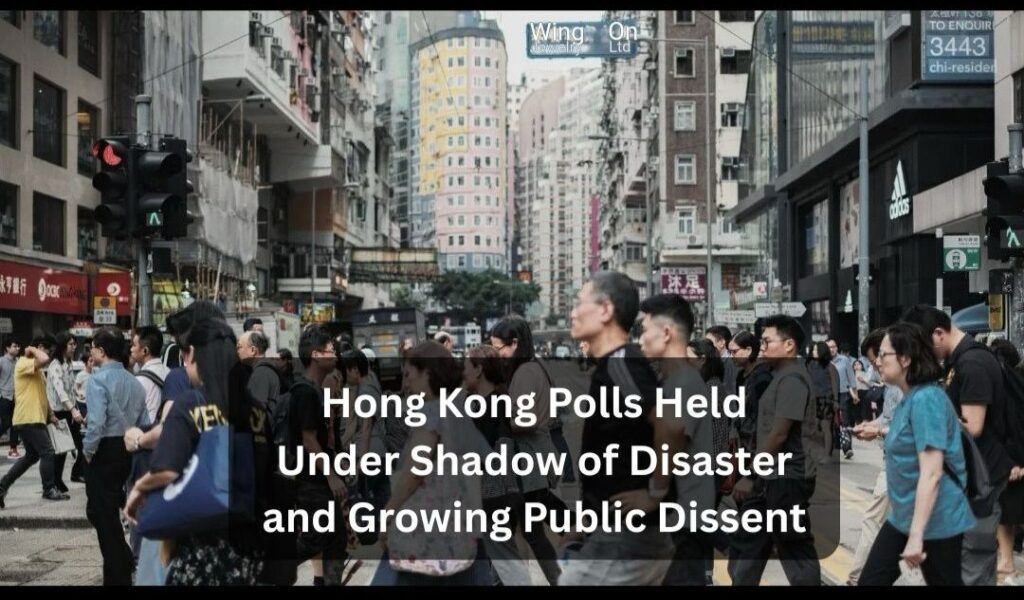
On what should have been an ordinary election morning, Hong Kong woke up to two very different realities. On one side of the city, polling stations opened their doors, campaign banners fluttered quietly, and officials urged citizens to participate in the city’s Legislative Council election. On the other, families were still searching for loved ones, smoke stains clung to shattered buildings, and grief hung heavy in the air after the deadliest fire Hong Kong has seen in nearly 80 years.
Instead of debating policies or candidates, one question dominated conversations across the city: Would anyone even come out to vote?
A Tragedy That Changed Everything
Just days before the election, disaster struck the Tai Po district near Hong Kong’s border with mainland China. A massive fire tore through seven residential towers in a public housing estate that had only recently undergone renovation. What began as a routine emergency spiraled into catastrophe.
Flames climbed rapidly from floor to floor. Thick black smoke trapped families inside their homes. Many residents had only minutes — some only seconds — to escape. By the time the blaze was finally brought under control nearly two days later, at least 159 people had lost their lives. Hundreds more were injured, and thousands were displaced.
Authorities later confirmed what many residents had already feared: flammable, substandard renovation materials had made the fire far deadlier than it should have been. For grieving families, this revelation transformed sorrow into outrage.
“It wasn’t just an accident,” one resident said quietly near the ruins. “It was neglect.”
Heavy Police Presence, Heavy Public Anger
On election day morning, Tai Po looked more like a disaster zone than a democratic district. Burned-out towers stood silent behind barricades. Dozens of police officers patrolled the streets around Wang Fuk Court, where the fire is believed to have started. Nearly 100 officers were deployed in the area alone, not to manage election crowds — but to prevent unrest.
Many residents saw the heavy security as another reminder of how disconnected they feel from those in power.
“There are more police here today than voters,” one shop owner muttered as he watched officers walk past his shuttered business.
An Election Without Real Choice
This election was already expected to struggle with public participation — even before the fire.
After the massive pro-democracy protests in 2019, Hong Kong’s electoral system was overhauled under Beijing’s guidance. Under the new rules, only candidates deemed “patriotic” and loyal to China are allowed to run. Independent voices and pro-democracy leaders who once energized the city’s political scene are now either jailed, silenced, or disqualified.
For many citizens, this has stripped elections of their meaning.
The result was clear in 2021, when only 30.2% of registered voters turned out — the lowest participation rate since Hong Kong returned to Chinese rule in 1997.
This year, with fresh wounds from tragedy and lingering political disillusionment, turnout was expected to fall even further.
Fear, Fatigue, and Silence
Across the city, many people simply stayed home.
Some said they were too emotionally exhausted to think about politics while their neighbors were still being identified at morgues. Others admitted quietly that they no longer believe voting can change anything. Many were afraid to speak at all.
Near the fire site, 78-year-old Mr. Cheng stood leaning on a walking stick, watching investigators move through the ruins. He shook his head slowly.
“We lost everything in one night,” he said. “Our friends, our homes, our trust. Now they want us to vote as if nothing happened.”
When asked if he planned to cast his ballot, he paused for a long time before answering.
“What difference does it make anymore?” he whispered.
Government Calls for Unity, Public Feels Abandoned
Hong Kong’s leadership issued repeated appeals for calm and participation, urging citizens to “stand together in unity and stability.” Officials described the election as a sign that the city was returning to normalcy after years of unrest and the scars of the pandemic.
But for many on the streets of Tai Po — and far beyond — those words felt painfully disconnected from reality.
For families waiting to identify the bodies of loved ones…
For survivors who jumped from balconies to escape the fire…
For residents who warned about building safety long before disaster struck…
There was no sense of unity — only unanswered questions and quiet anger.
A City at a Crossroads
As ballot boxes filled slowly across Hong Kong, the contrast was impossible to ignore. Democracy continued on paper, while faith in the system continued to erode on the ground.
The deadly fire did more than destroy homes. It cracked open long-standing frustrations about governance, safety, accountability, and representation. For many, the tragedy has become a painful symbol of a city that feels increasingly unheard.
On this election day, Hong Kong did not feel like a city choosing its future.
It felt like a city still trying to survive its present.