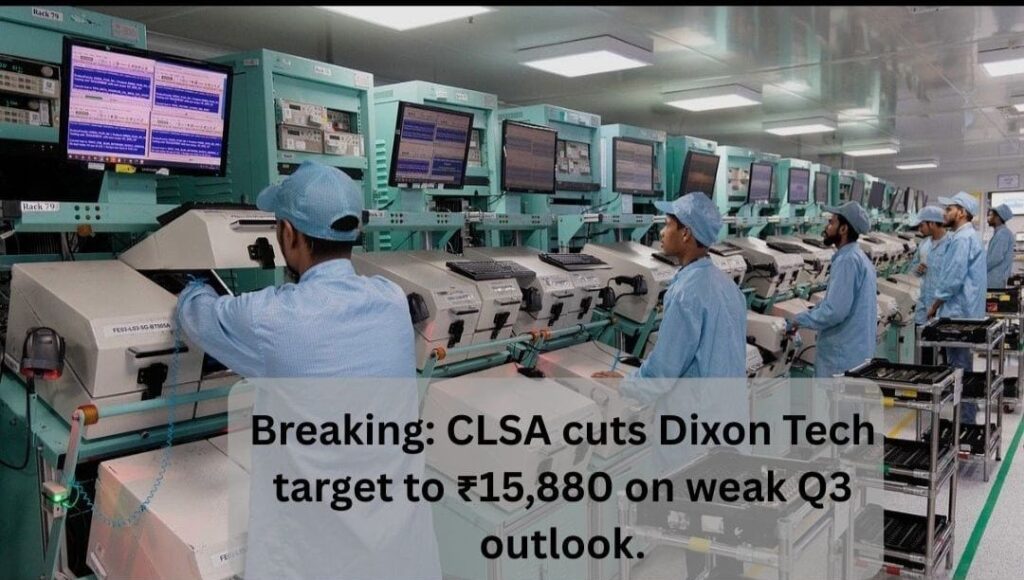
India’s electronics manufacturing success story, Dixon Technologies India Ltd, is once again in focus—but this time for reasons that have made investors cautious rather than excited.
Global brokerage firm CLSA has sharply reduced its target price on the stock, citing concerns over slowing momentum in the near term. The downgrade has sparked fresh debate in the market:
Is Dixon heading into a disappointing Q3FY26, or is this simply a temporary pause in an otherwise strong long-term growth journey?
Let’s take a closer look at what’s driving CLSA’s cautious stance—and what it could mean for investors.
Q3FY26 Outlook: Growth Likely to Stall
According to CLSA’s latest assessment, Dixon Technologies may face a challenging third quarter in FY26. The brokerage expects:
- Flat year-on-year revenue growth in Q3FY26
- A sequential decline in revenue compared to the previous quarter
This signals a noticeable slowdown, especially for a company that has delivered rapid expansion over the last few years. CLSA believes softer demand conditions and operational challenges are beginning to show up in quarterly numbers.
Adding to the concern, volume growth has not picked up as expected, and margin improvement—particularly in newer business segments—has been slower than earlier projections.
Earnings Estimates Take a Hit
Reflecting these near-term pressures, CLSA has significantly revised its earnings expectations for Dixon Technologies:
| Financial Year | EPS Revision |
|---|---|
| FY26 | Cut by 16% |
| FY27 | Cut by 17% |
These downward revisions are based on multiple factors:
- Slower-than-anticipated volume ramp-up
- Delays in margin expansion
- Risk that the company may need to trim its FY26 guidance if weak trends continue
Together, these elements introduce short-term uncertainty, which explains the recent pressure on the stock price.
Short-Term Pain, But Long-Term Confidence Remains
Despite lowering its near-term forecasts, CLSA has not turned pessimistic on Dixon’s overall business model. In fact, the brokerage has left its FY28 earnings estimates unchanged, signaling confidence that the current slowdown is temporary rather than structural.
This suggests CLSA expects performance to recover once demand stabilizes and execution improves across key segments.
Backward Integration: The Key to Future Margin Growth
One of the most important positives highlighted by CLSA is Dixon’s progress in backward integration, especially in smartphone manufacturing.
By producing more components in-house instead of relying on external suppliers, Dixon aims to:
- Reduce costs
- Improve operating margins
- Gain better control over its supply chain
While this strategy takes time to reflect in financials, successful execution could significantly strengthen profitability over the medium to long term.
Target Price Cut — But Upside Still Exists
CLSA has slashed its target price on Dixon Technologies from ₹18,800 to ₹15,880, a steep reduction that initially rattled investor sentiment.
However, there’s an important detail investors shouldn’t ignore:
Even after the cut, the revised target still suggests around 34% upside from current market levels.
Crucially, CLSA has retained its ‘Overweight’ rating, indicating that it continues to believe Dixon can outperform peers once sector conditions improve.
Why the Entire EMS Sector Is Struggling
Dixon’s near-term challenges are not unique. The broader electronics manufacturing services (EMS) sector has faced pressure due to:
- Temporary demand slowdown
- Delays in government incentives and subsidy disbursements
- Global geopolitical uncertainty affecting supply chains
- Margin pressure across manufacturing operations
These headwinds have dampened sentiment across EMS stocks, even though long-term fundamentals tied to India’s manufacturing push remain intact.
What Should Investors Keep in Mind?
For those tracking Dixon Technologies closely:
- Short term: Expect volatility and potentially subdued performance around Q3FY26 results.
- Medium to long term: The structural growth story remains compelling, supported by rising electronics demand, smartphone manufacturing, and India’s push to become a global manufacturing hub.
If backward integration delivers the expected margin gains and volume growth revives, Dixon could return to a stronger growth trajectory over the coming years.
CLSA’s downgrade serves as a reminder that even high-quality companies go through challenging phases. While Dixon Technologies may face a softer Q3FY26, the brokerage’s continued confidence in its long-term outlook suggests the slowdown is cyclical—not a breakdown in fundamentals.
For patient investors with a long-term horizon, Dixon Technologies still stands out as one of the most important players in India’s rapidly evolving electronics manufacturing ecosystem.