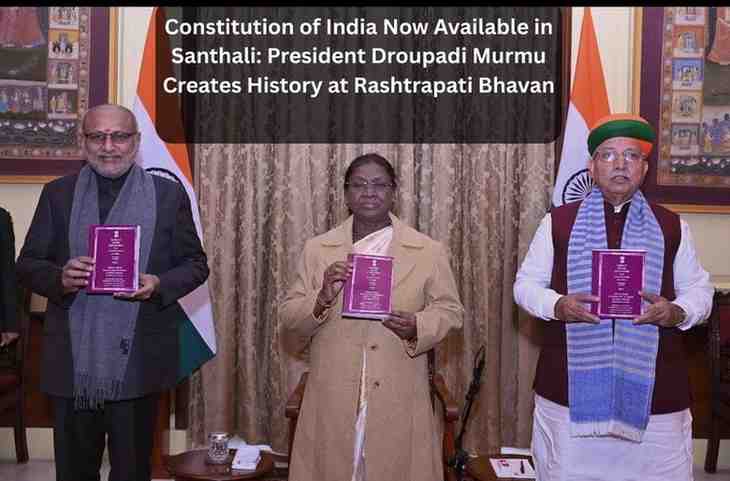
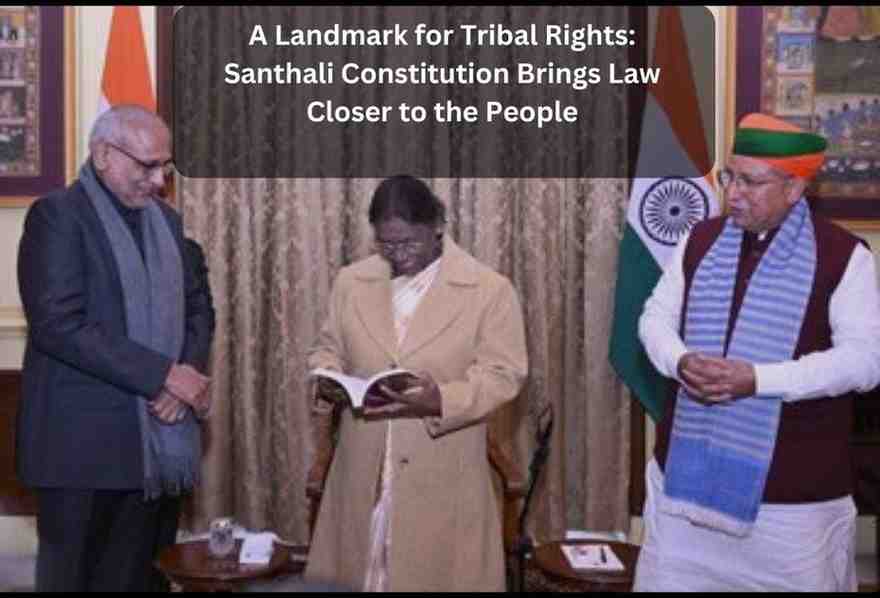
India has added another proud chapter to its democratic and cultural journey. In a deeply symbolic and historic move, Droupadi Murmu, the President of India, formally released the Santhali version of the Constitution of India, written in the traditional Ol Chiki script, at a special ceremony held at Rashtrapati Bhavan.
The moment resonated far beyond the grand halls of the presidential residence. For lakhs of Santhali-speaking citizens across eastern India, this was not just the launch of a translated book — it was a long-awaited recognition of their language, culture, and rightful place within the Indian democratic framework.
A Constitution That Finally Speaks the Language of Its People
The Constitution of India is often described as the soul of the nation. It defines citizens’ rights, duties, freedoms, and the structure of governance. Yet for decades, many tribal communities could only access it through languages that were not their own.
With the release of the Santhali version, a crucial gap has finally been bridged.
Addressing the gathering, President Murmu described the occasion as one of pride, joy, and fulfillment. She emphasized that Santhali-speaking citizens can now read, understand, and emotionally connect with the Constitution in their own language and script — something that holds immense significance for true democratic participation.
This initiative sends a powerful message: democracy is strongest when people can understand it in the language they think, speak, and live by.
Santhali Language and Ol Chiki: Preserving Identity Through Script
Santhali is among the most widely spoken tribal languages in India, deeply rooted in the lives, traditions, and oral history of communities spread across:
- Jharkhand
- Odisha
- West Bengal
- Bihar
- Assam
The language received national recognition in 2003 when it was added to the Eighth Schedule of the Constitution through the 92nd Constitutional Amendment. However, recognition alone was not enough.
Santhali is traditionally written in the Ol Chiki script, developed in the 20th century to preserve the authentic sounds, expressions, and cultural essence of the language. For years, the absence of official documents in Ol Chiki meant that many Santhali speakers remained distant from formal governance and legal awareness.
The publication of the Constitution in Ol Chiki changes that reality in a meaningful way.
Why This Moment Matters Beyond Symbolism
This initiative goes far beyond ceremonial value. Its real importance lies in how it touches everyday lives.
By making the Constitution available in Santhali:
- Lakhs of people can now read their rights and duties directly
- Legal awareness in tribal regions will significantly improve
- Indigenous languages receive not just respect, but practical empowerment
- Democracy becomes more inclusive, accessible, and participatory
The move aligns strongly with the broader national vision of “Sabka Saath, Sabka Vikas, Sabka Vishwas”, ensuring that inclusion is not limited to policy documents but reflected in action.
President Droupadi Murmu’s Personal and Cultural Connection
This moment carried special emotional weight because of President Murmu’s own background. Coming from a tribal community herself, her association with this initiative added depth, authenticity, and sincerity to the occasion.
By personally unveiling the Santhali Constitution, she reinforced a powerful idea:
representation matters — and it matters at the highest level.
Her leadership continues to reflect a strong commitment to uplifting marginalized communities through education, language recognition, and cultural dignity.
Long-Term Impact on Education and Tribal Empowerment
The effects of this initiative are expected to be long-lasting and transformative:
- Schools and colleges in tribal areas can use the Santhali Constitution as a teaching resource
- Community leaders and social workers can spread constitutional awareness more effectively
- Young people will feel inspired to preserve their language and heritage
- It sets a strong precedent for translating the Constitution into other tribal and regional languages
Over time, this can strengthen trust between institutions and communities that have often felt overlooked.
A Step Toward a More Inclusive India
India’s strength lies in its diversity — of languages, cultures, traditions, and identities. The release of the Constitution in Santhali reminds us that inclusion is not complete unless people can engage with the nation’s most important document in their own voice.
This initiative transforms the Constitution from a distant legal text into a living guide that speaks directly to the people it governs.
Conclusion: More Than a Translation, a Celebration of Equality
The launch of the Santhali version of the Constitution of India in Ol Chiki script is not merely a publication milestone. It is a celebration of identity, dignity, and democratic equality.
It tells every tribal citizen that their language matters, their culture matters, and their understanding of the Constitution matters.
In doing so, India takes another confident step toward becoming not just the world’s largest democracy — but one of its most inclusive.