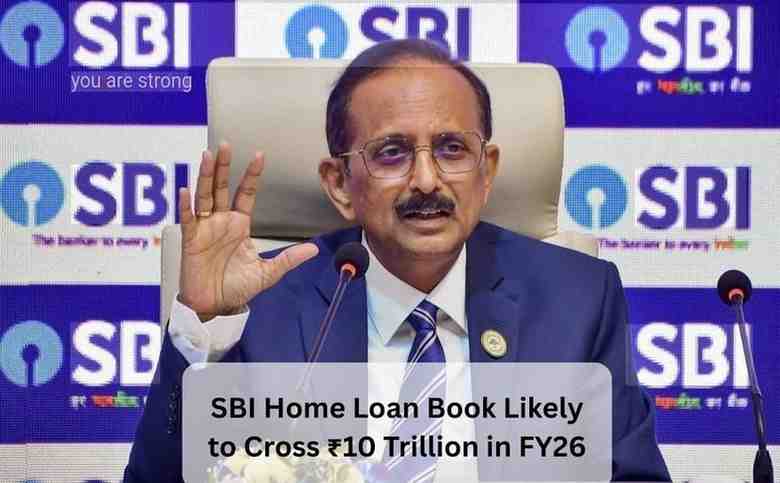

State Bank of India is on course to achieve a major milestone in the housing finance space. Driven by steady demand for residential properties and a relatively supportive interest rate environment, the country’s largest lender expects its home loan portfolio to cross ₹10 trillion in the financial year 2026.
This achievement, once reached, will further strengthen SBI’s position as the biggest mortgage lender in India and highlight the growing role of retail lending in the banking sector.
Home Loans Become SBI’s Largest Growth Engine
Home loans have now emerged as the single biggest business segment for SBI. The bank’s housing loan portfolio has already crossed ₹9 trillion and accounts for more than 20 percent of its total assets. This clearly shows how central housing finance has become to SBI’s overall business strategy.
With a steady annual growth rate of around 14 percent, the bank is confident of touching the ₹10 trillion mark in the next financial year. The growth reflects strong demand from homebuyers across cities and towns, along with the bank’s cautious and disciplined lending approach.
A Steady Growth Journey Built Over Years
SBI’s rise in the housing loan segment has been gradual and well-paced rather than aggressive. The bank crossed the ₹1 trillion home loan milestone in March 2011. Over the years, the portfolio expanded steadily, reaching ₹8.31 trillion by the end of FY25 and moving beyond ₹9 trillion in November 2025.
In FY25 alone, the home loan book grew by over 14 percent year-on-year, underlining the resilience of housing demand even amid changing economic and interest rate conditions.
Asset Quality Remains a Key Strength
Despite the rapid expansion, SBI has managed to maintain excellent asset quality in its home loan portfolio. Non-performing assets in this segment have consistently remained below 1 percent, which is among the best in the Indian banking industry.
At the end of FY25, the gross NPA ratio for home loans stood at just 0.72 percent. This has been achieved through careful borrower assessment, continuous monitoring, and early identification of potential stress. Home loans continue to be one of the most stable and low-risk lending categories for banks.
RAM Segment Powers Overall Loan Growth
SBI’s strong performance is not limited to housing loans alone. The broader Retail, Agriculture, and MSME segment has emerged as the backbone of the bank’s credit growth. This segment now contributes nearly 67 percent of the total loan book and crossed ₹25 trillion in September.
Encouraged by strong demand across sectors, SBI has raised its overall credit growth guidance for the year from 12 percent to 14 percent. MSME loans are expected to grow at 17–18 percent, while retail and agriculture lending is likely to expand at around 14 percent. Gold loans and unsecured personal loans are also seeing healthy traction.
Economic Recovery Supporting Borrower Confidence
Improving economic conditions, better income visibility, and rising consumer confidence are supporting credit demand across the country. Housing continues to remain a priority for Indian households, supported by urbanisation, changing lifestyles, and policy measures that encourage home ownership.
SBI expects these factors to keep demand for home loans strong in the coming years, particularly in the mid-income and affordable housing segments.
Why the ₹10 Trillion Milestone Matters
Crossing the ₹10 trillion home loan mark will be more than just a numerical achievement for SBI. It will reflect strong borrower trust, disciplined risk management, and the bank’s dominant position in India’s housing finance market.
For the bank, home loans offer long-term stability, predictable cash flows, and lower default risks compared to many other lending categories, making them a crucial pillar of sustainable growth.
SBI’s journey toward a ₹10 trillion home loan portfolio in FY26 highlights the strength of India’s housing market and the growing importance of retail credit. With solid asset quality, broad-based loan growth, and improving economic conditions, the country’s largest lender appears well-positioned for steady and sustainable expansion in the years ahead.