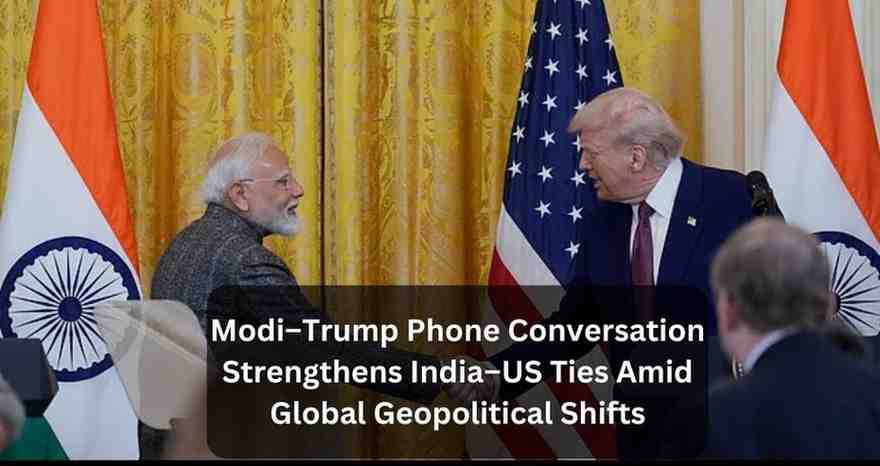
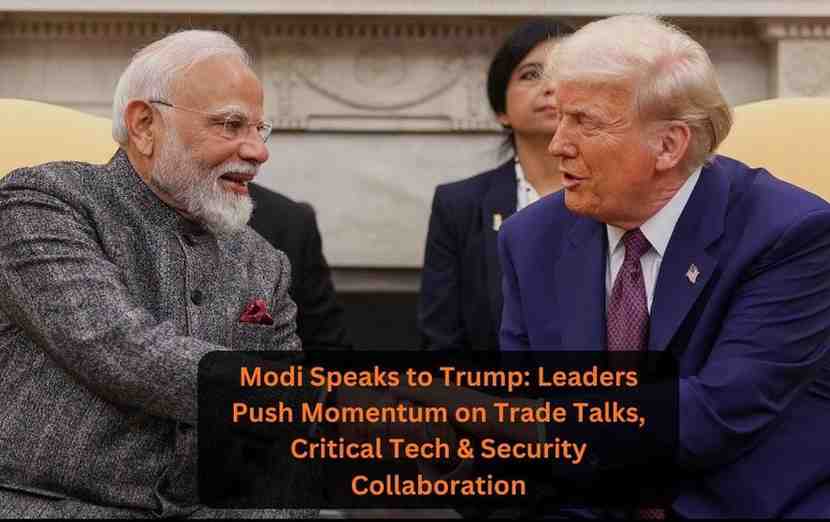
In a significant diplomatic moment, Prime Minister Narendra Modi and U.S. President Donald Trump held a detailed and wide-ranging phone conversation on Thursday — a discussion that went far beyond a courtesy exchange. Their dialogue touched on nearly every crucial pillar of the modern India–US partnership: trade, technology, defence, energy, and evolving global security challenges.
The timing of the call is especially noteworthy. With geopolitical alignments shifting rapidly, the world’s major powers are reassessing alliances, strategies, and spheres of influence. India, which has been carefully strengthening ties with the US, Europe, the Global South, and Russia, used this conversation to underline its intention to maintain a balanced yet forward-looking foreign policy.
A Warm Conversation That Reflects Confidence in the Partnership
Both sides described the interaction as friendly, constructive, and forward-leaning. Shortly after the call, PM Modi took to X to share:
“Had a very warm and engaging conversation with President Trump. We reviewed the progress in our bilateral relations and discussed regional and international developments. India and the U.S. will continue to work together for global peace, stability and prosperity.”
This public message reinforces India’s strategy of keeping the US relationship strong, even as New Delhi simultaneously engages with other global powers — including Russia, whose influence continues to play a major role in India’s strategic calculations.
The India–US Comprehensive Global Strategic Partnership: A Modern Diplomatic Backbone
Since 2020, India and the U.S. have operated under the banner of a Comprehensive Global Strategic Partnership, which essentially acts as a high-level framework for cooperation in:
- Defence and national security
- High-end and emerging technologies
- Trade and economic connectivity
- Climate and clean energy
- Indo-Pacific stability
- Counterterrorism
- Space exploration and satellite technology
Modi and Trump reviewed the progress across these areas and expressed satisfaction that cooperation has remained steady even during periods of global political and economic uncertainty.
Trade Negotiations Take Centre Stage
Trade remains an area with immense potential — and equally significant challenges. It is also one of the most closely watched segments of the India–US relationship.
Where things stand right now
Commerce Minister Piyush Goyal recently highlighted that:
- Five negotiation rounds have already taken place
- Talks are going on smoothly without pressure from either side
- Both governments want an agreement that genuinely benefits their economies
- The USTR delegation in India is focusing on understanding priorities instead of rushing for concessions
Goyal emphasized:
“A deal is done when both sides benefit. Negotiations shouldn’t be tied to deadlines because that leads to mistakes.”
This approach mirrors the tone of the Modi–Trump call — deliberate, strategic, and focused on building a long-lasting trade architecture rather than seeking quick wins.
Defence and Security: A Pillar Growing Stronger Every Year
Defence cooperation has become one of the most dynamic components of the India–US partnership. Over the past decade, the nations have:
- Signed multiple foundational agreements
- Expanded joint training and military exercises
- Increased interoperability between forces
- Boosted the flow of defence technologies and investments
During the phone call, the leaders discussed:
1. Future-Ready Defence Collaborations
- Co-development of advanced defence platforms
- Strengthening supply chains for critical military hardware
- Expanding American defence technology investment in India
- Supporting maritime security in the Indo-Pacific
2. The COMPACT Framework
They also reviewed progress under COMPACT, which stands for:
Critical Opportunities for Military Partnership, Peace, Advanced Commerce and Technology
It is a multi-domain initiative connecting defence strategy with cybersecurity, innovation, and commercial ecosystems.
3. Indo-Pacific Strategy
Both Modi and Trump reaffirmed the importance of:
- Open and secure sea lines
- A stable, rules-based regional order
- Counterterrorism cooperation
- Active coordination in the face of tensions in the South China Sea and Taiwan Strait
India continues to be viewed by Washington as a central pillar of the Indo-Pacific vision.
Critical and Emerging Technologies: The Most Future-Defining Partnership
One of the strongest messages from the call was the shared commitment to deepen collaboration in critical technologies such as:
- Semiconductors and resilient chip supply chains
- 5G/6G and telecom security
- Artificial intelligence and quantum tech
- Space science and satellite launches
- Green hydrogen and clean-tech innovation
- Cybersecurity and digital infrastructure
Both countries recognize that securing these sectors is vital for national security and economic progress in the decades ahead.
Energy Security: A Joint Priority Amid Global Volatility
The leaders also spoke about strengthening energy partnerships at a time when global markets are being disrupted by:
- Russia–Ukraine conflict
- Middle East tensions
- Shifting oil and gas supply routes
India and the US are working closely in:
- LNG and crude oil trade
- Renewable energy systems
- Civil nuclear cooperation
- Hydrogen technology
- Critical minerals essential for EVs and batteries
Energy stability is becoming a strategic pillar, not just an economic issue.
Global and Regional Issues: A Strategic Alignment of Views
Modi and Trump exchanged perspectives on several major international developments. While official statements didn’t list specifics, the likely topics include:
- Ukraine conflict: India’s balanced engagement with Russia is being closely watched by Washington.
- Middle East: Instability affects India’s large diaspora and global energy supplies.
- Indo-Pacific tensions: The South China Sea and Taiwan Strait remain hotspots.
- Counterterrorism: Both leaders have a shared understanding of the evolving terror landscape.
The agreement to stay “regularly in touch” indicates that more high-level consultations may follow.
Putin’s Visit to India: The Strategic Backdrop
The Modi–Trump call occurred soon after Russian President Vladimir Putin visited India for a high-profile two-day summit — his first in-person visit after the Ukraine war began in 2022.
This visit drew global attention for several reasons:
- India is among the few nations maintaining strong ties with both Russia and the US
- A viral photograph of Modi and Putin sharing a moment in a car triggered debate in Washington
- U.S. Congresswoman Sydney Kamlager-Dove even held up the picture during a congressional discussion on India–US ties, remarking: “This poster is worth a thousand words.”
The Modi–Trump phone call, therefore, helped reassure Washington that India is not drifting away — instead, it is pursuing a multi-aligned foreign policy while keeping the US partnership at the forefront.
What This Call Really Signals
The conversation between Modi and Trump sends several strategic messages:
1. The India–US relationship remains strong and dependable.
Despite global political shifts, the partnership continues to deepen.
2. Technology and trade are becoming the new engines of cooperation.
Defence remains crucial, but digital and tech sectors are increasingly defining the relationship.
3. India is successfully balancing major global powers.
New Delhi continues to engage with Russia, the US, and others without compromising its strategic autonomy.
4. Washington views India as vital to the Indo-Pacific.
India’s role in regional stability is becoming more central to U.S. strategy.
5. Expect more frequent high-level engagements.
The call underscores a shared willingness for continued dialogue.
The Modi–Trump phone conversation was more than a diplomatic courtesy — it was a reflection of how far the India–US relationship has evolved. What began decades ago as a primarily defence-oriented partnership has now expanded into a comprehensive strategic framework that spans technology, trade, energy, and global security.
As the world navigates economic realignments, disruptive technologies, and rising geopolitical tensions, India and the United States increasingly view each other as essential strategic partners.
The warmth of the call, combined with the depth of topics covered, indicates that the relationship is not only stable — it is poised to grow even stronger in the years ahead.